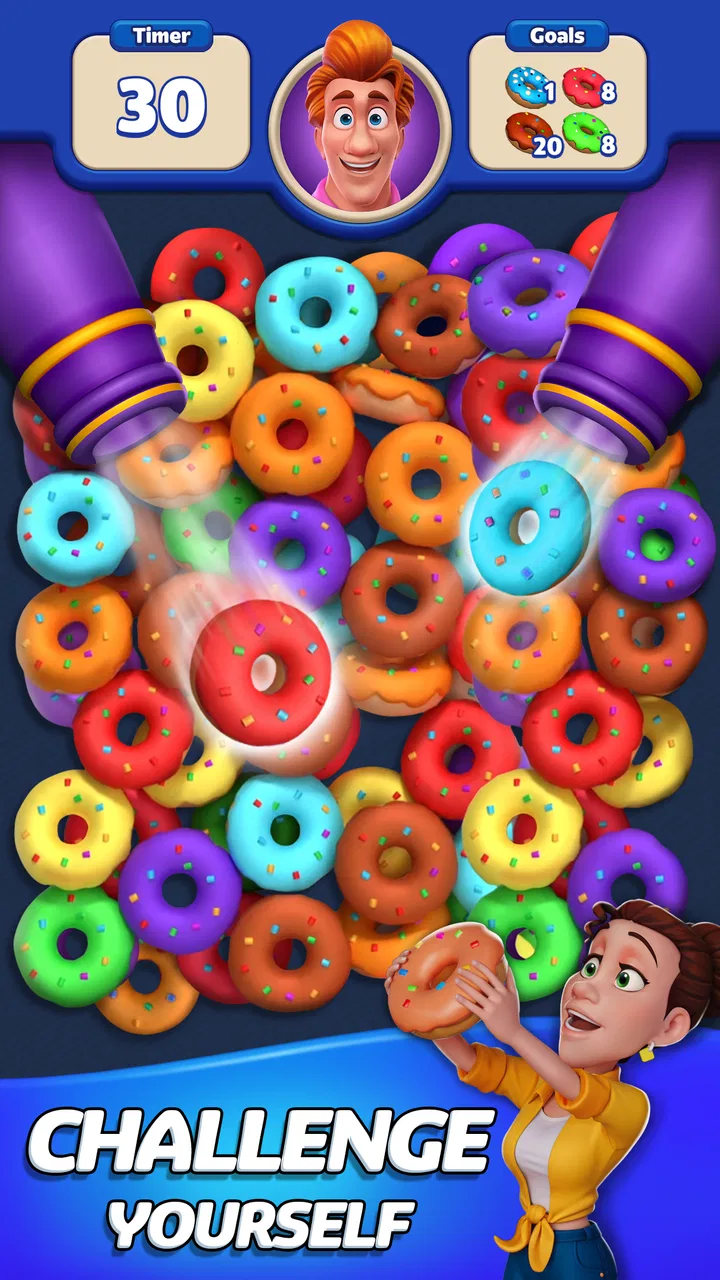
Blitz Busters
- 4.6
- Rating
- 1.00M
- Installs
- Free
- Price

 Analysis by App-foxy
I spent time with Blitz Busters as a casual 3D puzzle game, and my first impression was that it aims for quick, low-pressure sessions rather than deep, story-driven play. The basic appeal is easy to understand: you look at a three-dimensional puzzle, work out what belongs together, and keep moving through a sequence of challenges. That makes it a natural choice for a short break, especially when I want something more interactive than scrolling but less demanding than a full strategy game.
It is a free game from Spyke Games, listed in the puzzle category for everyone. The current release is version 2.4.2, and it runs on devices using Android 7.0 or later. The game has passed the million-install mark and holds a 4.6 average from around nine thousand ratings, with roughly one thousand two hundred written reviews. Those figures suggest that its simple format has found a sizeable audience, although popularity alone does not tell me whether it will suit every kind of puzzle player.
How Blitz Busters Feels in Everyday Play
When I play Blitz Busters in an everyday setting, I find it works best as a small, self-contained pause rather than something to keep open in the background. I scan the scene before tapping, which helps me spot choices that may clear space and make later objects easier to read. That simple habit also points to the next question: how a first-time player can settle in and reach a satisfying first solve without rushing.
You May Also Like

 Blood Strike: 2.5 Anniversary
Blood Strike’s Loadouts Turn Every Drop Into a Tactical Gamble
A close look at Blood Strike’s custom loadouts: how fast access to signature weapons reshapes its battle royale rhythm, rewards preparation, and narrows the gap between fights.

 Pandora - Music & Podcasts
Pandora’s Music Is Easy to Start, but Harder to Recover
Pandora’s strength is its low-effort path from a seed to a station. Its weak spot is how much confidence it asks you to place in connection, setup, and quiet recovery.

 8 Ball Pool
 Is Built on Rivalries, Rematches, and Routine
A close look at the rivalries, rematches, shared routines, and unanswered safety questions that turn a quick pool match into a persistent mobile community.

 Samsung Music
’s Quiet Strength Is Playing What You Already Own
Its reach comes less from spectacle than from dependable access to a personal library. That simplicity is both the app’s strongest retention engine and its ceiling.

 AccuWeather: Weather Radar
AccuWeather Review: A Quick, Clear Forecast for Everyday Decisions
For everyday plans, the best forecast is the one you can understand quickly. AccuWeather makes rain timing, radar, and local conditions easy to act on, with a few trade-offs.

 Hill Climb Racing
Why Hill Climb Racing Still Turns Crashes Into One More Run
A tiny car, a bumpy hill and one more upgrade: Hill Climb Racing keeps resurfacing because its simple chaos makes every near-miss feel personal.
More From Our News Desk



Quick rounds make it easy to start
The strongest part of the experience is its low entry barrier. I do not need to learn a complicated rule set before beginning, and the three-dimensional presentation gives ordinary matching and sorting ideas a more tactile feel. Instead of staring at a flat grid, I am encouraged to inspect objects from different angles and decide what should be selected next. That extra visual layer is what separates it from a basic tile-matching pastime.
This format works particularly well when I have only a few minutes. A train ride, a queue, or the final part of a lunch break gives me enough time to play without committing to a long campaign. I can also stop thinking about it immediately afterward, which is useful when I want a small mental reset rather than a game that demands constant attention.
The trade-off is that the same accessibility can make the opening feel familiar to experienced puzzle fans. Players who prefer elaborate deduction, narrative clues, or multi-stage logic may find the central loop lighter than expected. I see it as a game built around visual recognition and quick decisions, not as a replacement for a traditional brain-training suite or a serious logic puzzler.
What the three-dimensional view adds
The 3D perspective is not just decoration. It changes how I approach each puzzle because an object can be partly hidden, visually similar to another piece, or easier to understand after rotating my attention around the scene. I have to slow down enough to inspect the arrangement, but not so much that the game loses its casual rhythm.
That creates a useful tension. Playing too quickly can lead to a mistaken selection, while overthinking every object makes a simple challenge feel unnecessarily slow. My best approach is to scan the whole scene first, identify obvious groups, and only then begin clearing items. This keeps the screen readable and reduces the chance of making a rushed choice.
A small but important tip is to avoid focusing on the most noticeable object immediately. Bright or central pieces naturally attract attention, yet they are not always the best starting point. I found it more efficient to look for combinations that open up the surrounding area. In a 3D puzzle, clearing space can be more valuable than taking the easiest visible match.
Perceived speed and the right expectations
The game is designed around short puzzle actions, so it generally feels more responsive when I treat each session as a series of small decisions rather than a long uninterrupted task. The perceived pace depends heavily on how crowded the scene is and how quickly I can read the objects. Simple arrangements feel brisk; busier ones naturally ask for more visual checking.
I would not choose it if my main requirement were a competitive puzzle with precise timing or a system built around high-speed reactions. Its appeal comes from accessible visual problem-solving, not from pushing the device or the player to the limit. That distinction matters because the store summary presents it as an adventure for the brain, while my experience is closer to relaxed 3D puzzle clearing with occasional moments of pressure.
On a recent kind of everyday scenario, I can imagine opening it while waiting for an appointment. I would play with sound lowered, complete a few decisions, and put the phone away when my name is called. The game suits that interruption-friendly pattern better than a title that punishes me for leaving in the middle of a long stage.
When heavier play becomes less comfortable
The most demanding moments are not necessarily about complex rules. They come when I continue playing for a longer stretch and the visual field begins to feel busy. Repeatedly inspecting similar shapes can become tiring, particularly on a smaller phone where fine details occupy less screen space. That is a limitation of the format rather than a flaw unique to one level.
For longer sessions, I recommend changing the way I play. Instead of trying to clear everything as quickly as possible, I pause after each obvious group and reassess the remaining layout. This reduces visual clutter in my head and makes the next decision easier. It also helps prevent the common mistake of tapping based on color alone when shape and position are more useful clues.
Another practical trade-off is attention. Although the game is casual, it is not completely mindless. If I am watching television, walking, or frequently switching between messages, I am more likely to miss a useful relationship between objects. It is better suited to a short period of focused relaxation than to background play while doing something else.
Stability and recovery in normal use
For a puzzle game of this kind, reliability is mostly about whether I can return to a session without unnecessary friction and whether the presentation remains comfortable during repeated play. The available release is version 2.4.2, and the broad adoption reflected in its install count and ratings gives me confidence that it is intended for regular everyday use rather than a brief experiment.
I still prefer to approach any mobile game with sensible expectations. A title that uses 3D visuals may place more demand on a phone than a plain two-dimensional matching game, especially when the screen is busy or I keep it open for a long time. I would not assume that an older handset will feel identical to a newer one simply because both meet the operating-system requirement.
If I need to stop suddenly, the safest habit is to finish a clear action before switching away whenever possible. That is good practice for any puzzle session, because it makes it easier to remember what I was examining. I also avoid repeatedly restarting the game during a busy moment; giving the app a moment to return is more sensible than treating every delay as a failure.
The game’s casual structure helps with recovery from mistakes. I do not feel that one wrong decision ruins the entire reason for playing. That makes it less stressful than puzzle alternatives built around strict timers, limited attempts, or competitive rankings. On the other hand, players who want meaningful consequences may find the forgiving tone less exciting.
Device constraints worth considering
The minimum operating-system requirement is Android 7.0, so compatibility is reasonably broad for Android users. Compatibility is not the same as identical performance, however. Screen size, available memory, background activity, and the age of the device can all affect how comfortable a 3D puzzle feels. A small display may make object inspection harder, while an older phone may be less pleasant during extended sessions.
I would install it on a device with enough free space and close demanding apps if the game feels less fluid than expected. Those are ordinary steps, but they matter more here because the visual layout is central to solving the puzzle. If details appear cramped or the phone becomes warm during a long session, shorter play periods are a practical workaround.
It is also worth remembering that the game is free to download but includes purchases ranging from $0.99 to $149.99 per item. I see that as an important consideration for families, even though the age classification is Everyone. I would review purchase controls before handing the phone to a child, and I would decide in advance whether I am willing to spend anything. The free entry point is useful, but optional purchases can change how comfortable the overall experience feels for different players.
How it compares with other puzzle choices
Compared with a classic match-three game, this one puts more emphasis on spatial inspection and less on arranging pieces in a flat board. That makes it a better fit for someone who enjoys looking around a scene and spotting relationships between objects. A match-three alternative may feel faster and more immediately predictable, while this game gives visual depth a larger role.
Compared with a pure logic game, Blitz Busters is easier to pick up but usually less intellectually layered. A Sudoku-style or deduction-focused app is a better choice if I want rules that build toward complex reasoning. Here, the satisfaction comes from recognizing the next useful action and gradually making the scene clearer.
It also differs from large adventure games that use puzzles as part of a story. I would not download this expecting characters, exploration, or a narrative reason to continue. Its adventure language is better understood as a progression through puzzle situations. That focused design is a strength when I want immediate play, but a weakness if I need a world to become invested in.
Who will enjoy it most
I recommend it to people who like casual puzzles with a visual twist, especially those who want sessions that can fit around ordinary interruptions. It is approachable for newcomers, and the Everyone rating makes it suitable for a broad audience in terms of content. The main skill is patience with visual detail rather than knowledge of a complicated system.
It can also work for someone trying to replace a habit of opening social media whenever there is a spare minute. A short puzzle gives that moment a clear beginning and end. My advice is to use it deliberately: play while seated, finish a small section, and stop before the screen becomes tiring. That makes the game feel like a useful break instead of another endless feed.
I would skip it if I want a demanding competitive challenge, a rich story, or a puzzle system that keeps introducing advanced rules. I would also look elsewhere if I dislike 3D visual clutter or find object-matching games repetitive after a few sessions. The game’s strengths are narrow but clear, and they do not need to suit every player.
My practical play routine
My preferred routine is to begin with a quick scan, locate the easiest relationships, and then prioritize actions that expose more of the scene. I avoid tapping randomly because a wrong move can make the layout harder to read. When I feel my attention dropping, I stop rather than forcing myself through another round. This is more effective than treating every available minute as a reason to continue.
For a child or shared family device, I would explain that free installation does not mean every item inside the game is free. I would also keep the device in a comfortable position, since repeatedly tilting or bringing the phone close to the face makes visual puzzles less enjoyable. These small habits are more useful than chasing maximum speed.
For an older Android phone, I would begin with short sessions and judge comfort by the actual experience: does the scene remain easy to inspect, do actions feel consistent, and does the phone stay comfortable in the hand? If the answer is yes, the modest hardware requirement should make it a reasonable candidate. If not, a simpler two-dimensional puzzle may be the better choice even if both games are technically compatible.
Final performance verdict
Blitz Busters succeeds because it turns a familiar puzzle idea into something more spatial and visually engaging without demanding a long explanation. I like its suitability for brief sessions, its forgiving casual tone, and the way a careful scan can be more rewarding than hurried tapping. The 3D presentation gives it a distinct identity among lightweight puzzle games.
Its limitations are just as clear. Longer play can become visually tiring, the core activity may feel too simple for serious puzzle fans, and the presence of in-app purchases deserves attention on shared devices. Performance expectations should also remain realistic: the Android requirement is broad, but the comfort of a 3D game still depends on the phone and the length of the session.
Overall, I would recommend it to a friend who wants a free, approachable puzzle for waiting rooms, commutes, or short evening breaks. I would describe it as a relaxed visual challenge rather than a deep adventure or a high-speed test. Choose it for quick 3D puzzle sessions and easy access, not for complex strategy or a story-led experience.
FAQs for Blitz Busters
01What is Blitz Busters and how does the game work?
Blitz Busters is a fast-paced mobile puzzle game built around matching colorful pieces and completing objectives within a limited number of moves or time. During a typical session, you clear groups, create power-ups, and use strategic combinations to overcome increasingly difficult levels. The early stages are easy to understand, but later challenges require planning rather than simply tapping the largest available group.
02Is Blitz Busters free to download and play?
Blitz Busters can generally be downloaded and played without an upfront purchase, making it easy to try on a compatible Android or iOS device. However, the game may include optional in-app purchases for extra lives, boosters, coins, or other advantages. You can usually progress without spending money, although waiting for lives to refill or repeating difficult levels may be part of the free experience.
03Does Blitz Busters require an internet connection?
The basic puzzle gameplay may work in some situations without a constant internet connection, which is useful when traveling or playing with limited data. Nevertheless, online access can be necessary for advertisements, cloud synchronization, events, account features, updates, and in-app purchases. Availability of offline functionality can also vary by device and version, so it is best to launch the game online before relying on it offline.
04Are there advertisements or in-app purchases in Blitz Busters?
Blitz Busters may display advertisements, particularly between levels or when you choose to receive a reward such as additional moves or lives. Optional purchases can also be available for boosters, currency, and other resources. These features are not always required to enjoy the game, but they can influence the pace of progression. Parents should review device purchase settings if children will be playing.
05Is Blitz Busters suitable for children and what permissions does it use?
Blitz Busters is generally easy to learn and suitable for players who enjoy casual puzzle games, but parents should still check the age rating and the content of advertising shown in the current release. Before installing, review the permissions and privacy information listed on the official app store. Also remember that online services, analytics, advertisements, and optional purchases may affect the overall experience for younger users.
Pros
- Fast-paced matches are easy to learn and enjoyable in short sessions.
- Bright visuals and playful animations make the game appealing to casual players.
- Regular challenges provide extra goals beyond simply completing levels.
- Simple controls work well on both phones and tablets.
- Progression encourages experimentation with different moves and strategies.
Cons
- Difficulty can rise sharply
- especially in later stages.
- Limited moves may make some levels feel dependent on luck.
- Energy or waiting systems can interrupt longer play sessions.
- Frequent effects may feel visually busy on smaller screens.
- Players seeking deep competitive gameplay may find the mechanics repetitive.

Blitz Busters
Gallery